I’ve been posting so infrequently I have decided to close this blog at the end of the week. Thank you so much for having been a subscriber, especially my very first ever follower from New Zealand. Your support always made me smile.
I will continue to post periodically to my Facebook page under the same name. Please click the link below to continue following me.
Again, my heartfelt thanks to all of you for your support.
We had a popup tent to cover the grilling area, but it refused to pop this year and the cover had begun falling apart. So, we got a small pergola, which needed some help in the storms we’ve been having. Here’s a short video showing what I did to keep it from tumbling away.
BTW – I’m used to how loud the crows are, so I didn’t notice them when recording. Sorry about that.
We’ll eventually repair the popup to use over the picnic table. We needed one for that anyway.
Hope you liked the video. Time to get back to work. Bye!
Some days we wish we had a true homestead property out away from everywhere. Away from the pollution. A place away from the noise and the municipal rules preventing us from keeping small livestock and bees. Away from the artificially lit nights hiding the stars and forcing me to draw curtains, when I’d rather have windows open to the wind and the night. Our own clean water and power generated purely by the wind and sun. Greenhouse providing year-round food and tropical fruits. As I write this early in the morning, a lawn service is buzzing with mowers and weed whackers a few houses down.
One small blessing, the wind has the jets approaching the small, regional airport from the other direction. Although later we’ll have the loud cars and motorcycles of the twenty-somethings in the neighborhood. And the wind could change.
Don’t get me wrong. This is nothing like living on Chicago’s northside and in the flight path for O’Hare. I did fifty years of that and, on the whole, it’s much quieter and more peaceful here than any city neighborhood I lived in. And we do see more stars at night.
Still…
There are days when I want to be the only person around for miles; days when I wish the background noise was the surrounding forest and small livestock over traffic and trucks rumbling down the street from the industrial sector not so far away; days where I wish my morning coffee was paired with no man-made sounds.
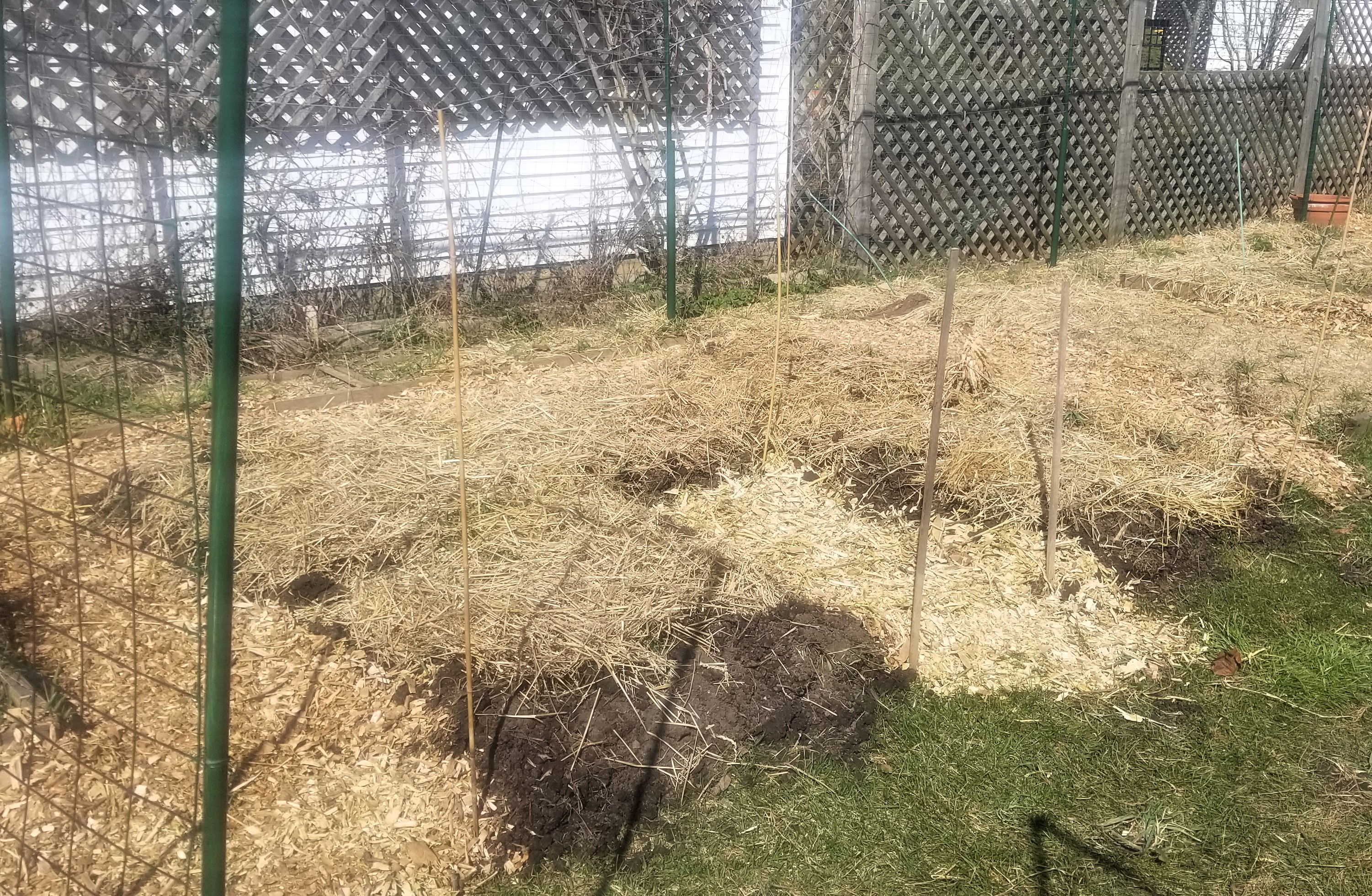
And no careless lawn service from next door crossing the property line and weed whacking my raspberries, which are three feet inside the line, causing me to lose an entire morning digging out and around the entire bed to mulch with straw and put up a small fence so they’ll know next time. They wiped out dozens of blooms and undoubtedly hundreds of berries I should have gotten this year. My current discontent is largely due to this debacle.
I get why your dyed-in-the-wool, hardcore homesteader wants to be far out in the country, even on the edge of the wilderness. People have a way of making life difficult, or at least frustrating. Homesteading is hard work, of course, and you’re usually on your own in terms of making it happen. But you don’t have people mowing over your plantings or helping themselves to the wood chips you got for your garden paths.
Trade-offs for living near Emergency Services and good health care, I guess.
Although it could be fun to turn coming into the city for treatments into an overnight trip; hit some cool restaurants and chill away from the chores for a night.
It’s curious to find myself thinking this way. Years back, when I was an ardent participant in the rat race, I swore up and down on a stack of bibles that I would never leave the city. My theme song was “You Belong to the City” by Glenn Frey. I felt at home in downtown Chicago and knew how to navigate the lower streets around all traffic. Everything I believed I would ever need was within walking distance or a short drive. I vacationed in other cities.
Except, now and then… My brother had a summer place in Wisconsin where I would visit, do a quick decompressing, slow down and help with some chores as a distraction when the stress got to be too much. My sister-in-law saw my visits in a different light. She believed the real me was the one slow-driving the country lanes, gazing at the unhindered field of stars, or chilling in the dockside restaurants. More than once, she told me I needed to have a house in the country. I smirked at the ridiculousness of the idea.
Yeah. Turns out she was right.
A house out in the country with acres between me and any neighbor would suit me just fine. Maybe with a nice sized pond or small lake outside the front door; not to fish, but simply to gaze upon from a screened in porch and fall into a meditative state.
I’m not too old to build a new and bigger garden. I keep expanding what we have as it is (to my daughter’s constant eye-rolling). Post treatments, I’m getting stronger by the day.
Once, while I was sitting for hours, hooked up to the IV chemo drugs, I drew up my idea of a perfect garden and livestock setup. The garden center was four, equal size rectangles with wide rows between them for fruit trees and bushes. Grapes covered inside walls of metal mesh, standing eight feet tall. This was to isolate, as much as possible, vegetable varieties which would easily cross-pollinate from each other, in the different sections. All around the outside of this inner square would be livestock pens and runs in long rectangles. Goats along one side, meat chickens along another, turkeys and a hatchery/rookery along the next, and the fourth outer portion would be laying hens on one side of the double gates and processing stations/building on the other. Altogether, it covered an acre. There was room to grow our own wheat and oats in addition to fruits and vegetables with this design. The greenhouse would be a separate structure.
The processing wing would house the equipment for butchering and freezing chickens and turkeys, for incubating the fertilized eggs from the meat chickens and turkeys, then raising the hatchlings to fledglings to young adults ready for introducing to the flock in a sustainable loop. It would need small pasteurization units for the laying hens’ eggs and milk from the goats. It would need facilities to blanch and freeze, or can our fruits and vegetables, plus dehydrators and a freeze dryer for herbs and spices and long-term storage of other produce. For the grains, a thresher, winnowing fan, and proper sized grinder would be required as well as ways to store it all for a year. If I thought I was busy now…
Solar panels would blanket the roofs of every structure, including the house and sheds, and wind turbines would rise above the corners and along the outer fence to power the whole operation. We’d be all electric and off-the-grid, maybe selling power into it. A deep well or two would provide pristine water. Instead of paying for a sewer hookup and waste water sanitization, we’d have a properly sized and maintained septic system.
At least, so my dream homestead goes.
In truth, we’d need to win the lottery to afford it. Self-sufficiency comes with setup costs. And the day will come (hopefully not that soon) when I do slow down. Maintaining this dream homestead will eventually require farmhands, if it didn’t from the start. Which would mean finding ways to monetize it and operating a profitable, small market farm if not something larger. Ramping up a business in my golden years.
Given that dose of reality and that my daughter has recently taken full and unencumbered possession of our house, our perfect plan is going to be accomplished on this quarter acre in a country town.
Which isn’t a bad thing.
We have unlimited, good quality water, so no worries about a well with insufficient flow or drying up. Even though we pay for connections to the city sewers, we have no worries about a septic tank or field failing. We’re going to install solar panels and small wind turbines to power the house, with a natural gas backup generator just in case. With the new power arrangement, we’ll be going all electric other than the backup generator and our canning kitchen stove. There’s also plenty of room for storing our canned and frozen produce in the basement. A root cellar would be nice, but I do have this sort of crazy idea….
I’ve almost finished our infrastructure here. With the front yard food forest expansion already in progress, there isn’t much more to be built. The apples are already producing. Over the next few years, I’ll finish with the large, heavy projects, like reforming the beds into something larger and building the Catio, then settle into a routine of maintaining the garden and preserving the harvests. I may not even notice it when I slow down because I’ll already be taking it easier.
Which is a major element of my desired retirement life.
So, all in all, we’re doing quite well with our smaller, urban homestead. Weed whacked raspberries are just a small setback, easily overcome and inconsequential over time. Small frustrations are to be expected no matter the size of one’s operation. I can deal with that.
I have a habit, good or bad, of seeing a post or a photo or a commercial and getting an idea stuck in my head. Some are fairly simple and straightforward. Others are, to put it simply, seriously over the top (like attaching a ladder to the ceiling for hanging plants). Regardless, the idea sticks and grows and won’t go away until you do something with it. That happened to me the other week thanks to a post in an organic gardening group.
For some time now, as we expanded the items we want to grow, especially medicinal herbs and for more authentic, ethnic fare, it’s become a struggle to decide where to put what. Do I stop growing some items in favor of others? Do I expand to new places in the front yard, which, unfortunately, is not as fertile as the back? Do I expand my container gardening, perhaps experimenting with different items to see if I can grow the same amount with a smaller foot print?
So, what did I do? Well, actually, I said yes to all three questions and added “found” space. Most of which was unplanned.
An answer to the first question was the only one addressed last year when I laid out the garden using our predetermined scheme. As I’ve mentioned in previous pieces, we created five groups of three families of vegetables to spread across our fifteen beds, which gave us a pre-planned five-year crop rotation system. The vertical growing beds went on a four-year plan. Everything was already set.
And then…
If I am a creature of any habit, it’s this: I’m going to upset my own meticulously thought-out plans with new ideas to make things better (one hopes).
Some of you might call this “not leaving well enough alone.” But I guess I’m just not all that ready to settle into a routine that never evolves. As I noted in my last post, my godmother once asked if I ever slowed down. Now that I’m almost back to 100%, I have to say the answer is simply, “No.”
Tweaking happens.
To start, in response to the first question, I had already stopped growing peas in favor of making room for winter squash and more sugar pumpkins. I wasn’t having much luck with peas despite trying several varieties over several years, and I’m the only one who eats them. It was a no-brainer to swap them out. If I absolutely need peas for a dish, frozen ones are not expensive. Forgoing peas also allowed us to switch out a couple varieties of bush beans for pole beans. This opened up space for Mexican herbs and Japanese greens and cabbages.
Second, I wanted to see if we could grow our own cumin. We already grow fennel in containers for seed because we use a lot. With our love of Tex-Mex (or at least mine), we go through a lot of cumin as well. Growing enough plants to get a sufficient amount of those tiny seeds requires considerable space. I wasn’t happy giving up most of a garden bed. So, last week, after that post got me thinking, I decided to use them as a border for the front walkway, a space we hadn’t tried growing anything in before and actually hadn’t planned out yet. We’re also relocating our shade garden plants, given there isn’t so much shade left after removing a couple of trees, and using that space for Jack O’Lantern pumpkins and bell peppers this year.
Third, items which will eventually become the understory of our burgeoning food forest, will go into containers which have sat unused for a couple of seasons. I also have ginger that sprouted in the pantry and is currently in water, growing roots in the greenhouse. Being a tropical, this will become a container plant so we can bring it in during the winter. We already have two pineapples I hope throw fruit this year. As for experimenting, I’m going to try potatoes in five-gallon buckets. Lay the seed spud on two inches of soil and fill to six inches, then continue adding soil as it grows until the bucket is full. If the idea works, I won’t have to dig to harvest; simply dump the bucket out.
The post, which triggered my thinking of restructuring in the first place, featured keyhole beds. This design is composed of two rectangular beds joined at the back, and having enough space in the center for you to get in to work them: the keyhole. Picture a big, thick, blocky C. If I were to convert fourteen of the fifteen beds (it has to be an even number), I would gain additional square footage equal to one and three-quarters of our eight-by-four-foot beds. This would solve our problems. At least until our constant add-ons exceeded that space. In the meantime, we’ll gain a few years and be able to focus more on building the front yard orchard/food forest.
We already needed to move beds one and two forward as they were too close to the vertical growing bed. We hadn’t planned on doing so this year. But, to try the keyhole design out, we shifted and converted them. If it’s manageable to maneuver around the extended design, we’ll convert the rest of the beds at the end of the year. So as not to upset my painstaking crop rotation scheme, I’ll treat the new sections as though they were separate mini-beds for the herbs and leafy vegetables with their own rotation.
Note: I did try reworking the over-arching schedule, regrouping and rearranging the placement of items. No bueno. I don’t need to reinvent that wheel. Mini-beds it will be. Keeping it to greens and herbs will remove any worries about cross-pollination, because I already worked those out in the current scheme.
As if to tell me this was a good plan, the universe dropped me a gift. On the way home from the gym, I came across tree cutters; your typical, independent guys rather than a large, landscaping company. I stopped and asked what they did with the wood chips. In short, I have a few more logs for the fire pit and about five yards of fresh wood chips to use as mulch in the walkways around the rebuilt beds as well as the strawberry patch, etc. This was something I’d been considering. I’m signed up with a service to bring me chips, but have been waiting and waiting and waiting. Then I find these fellows just as I was thinking I should redesign the beds. I’ll take that as a sign. The service suggests tipping the arborist $20. When I held out the bill for the guys the other day, he said, “For real?”
They would have been happy just getting rid of them rather than paying a landfill to take them. Given this would have cost me over $200 for material and delivery, this was a win-win. Including for my neighbor, who assumed they were trash being at the back of my lot, and helped himself to most of the logs and about half a yard of the chips before I caught him. I would have said yes had he asked; he’s a nice enough guy. But he is, as they say, not the sharpest tool in the shed, so it’s hard to be angry with him.
Anyway, I figured when I needed more wood chips, the tree cutters would be happy to bring me some without having to wait and wait and wait. As it turned out, he surprised me one day with an even bigger load and was happy enough just to give them to me.
Major life events change who you are. In 1976, Dr. Morris Massey created a training film entitled, Who You Are is Where You Were When – when a major life event occurred, taken in the context of where you were in life when it happened. I don’t remember when I saw it, or even if it was for a college course or a career seminar. The premise has stuck with me throughout the years. If something big happens to you or around you, you change, according to your circumstances. In a word, you adapt. But in a major way.
A cancer diagnosis and treatment definitely rank as a major life event. You would expect a brush with mortality to have an impact on you. Right? After all, trauma has been known to alter one’s brain chemistry. People have even died from the physical damage of broken hearts.
Only, it doesn’t feel like I went through a major trauma. Chemo was rough and came close to being emotionally devastating toward the end. However, I never felt as though my life was truly threatened. The cancer had not gone that far and, as my oncologist noted, I was very healthy otherwise. In fact, I had to calm one of my friends down when she started ranting against fate, saying how I was supposed to be enjoying my retirement, not dealing with cancer. I literally had to tell her, “I’m not dying.”
So, despite the fact I will live with this disease, under control, for the rest of my many years to come, I still don’t feel as though my life is in jeopardy. Because it isn’t.
Overall, I have to say the diagnosis and treatment were more of a hardship than an ordeal. Fourteen months later, I am almost fully recovered and living the retirement life I had envisioned. In no way am I feeling traumatized by this experience.
So, what do hardships do to you? Do they change you?
For some, they do nothing. Hard times don’t change them. For others, they put things into focus. You see your habits, patterns, and idiosyncrasies in a new light. They teach us to be resilient and to recalibrate our priorities. They cause us to change our outlook and to grow. Put us on a journey of self-discovery. I find myself in the latter category.
A few years ago, my Godmother asked me if I ever stopped moving. My to-do list was a mile long and I became upset if I wasn’t getting enough done every single day. I had a plan and I was compelled to get it done. But never could because it was always too ambitious. I told myself that if I would just be more efficient, stop wasting time during the day, I could finish my planned tasks. If I took a day or two off, I felt as though I was being a lazy. I didn’t let myself admit I was trying too hard.
I can’t say why, other than I was trained to do so from early on. In grammar school, I overheard my teachers saying to my parents I could be so much more if only I used my full potential. I heard my parents repeat this more than once to relatives at various gatherings over the years. While the pressure was less and more subtle through high school and into college, the seed had been planted. I needed to become more and more and more. I got one degree, then another, then another. Parties, back when I threw them, had to be bigger, better, with more drink and food options. More recently, the garden had to be bigger, better, and produce more.
Then the side effects of cancer treatment brought me to a halt.
When I couldn’t walk up a flight of steps without pausing to catch my breath, when I had no choice but to give myself time off after treatments. It forced me to reflect and re-evaluate how I was judging myself through what I could accomplish in a day, a week, a month. Today, I can fully admit I was trying too hard at everything: the blog, the garden, cooking, entertaining. You name, I overdid it.
Who was I trying to impress? My daughter and my friends were cool whether I finished my lists or not (except maybe the dishes per Beth), and the people who pushed me so long ago have all passed on to the other side. If they’re watching me now from over there, it’s on them if they’re not satisfied with what I do. I no longer care. I’m good with who I am and the me that is becoming post treatment.
Have I given up? Decided to just sit back and sip coffee in front of the computer all day? Said screw getting stuff done because I ended up with cancer anyway? All my efforts to be healthful and productive didn’t do me any good?
No. I just mellowed out.
I didn’t change what I was going to do here at home to make the life we want. I just got real about it.
I developed a long-term schedule for maintaining, expanding, and improving our homestead from the garden to home repairs to building projects. It currently goes out to 2029 and will always look forward five years. What I did differently was to stop and think as to how much time and energy and resources I would actually have to complete projects, then set realistic goals, focused on important tasks with truthful estimates of how long they would take.
For example, housecleaning. I have always and will probably always Hate housecleaning – and I mean that capital H. I did a perfunctory job of it, before, just a bit more than the bare minimum. I mean, I would have to clean the dust and cobwebs off the vacuum before using it. I took for granted that I would have always have the time and energy for it, however poorly I would sometimes do it. A clean house, though, is a healthy house. I rather need a healthy environment now. So, despite still loathing the activity, this has to be done. At first, I only managed one room a day as my stamina recovered. By November, I was able to deep clean each room by devoting an entire week to each one. That caught me up finally and now I clean the entire upstairs in one morning.
Except Beth’s room; she has so many knick-knacks and little stuff everywhere, I vacuum and wash what floor I can find and sort of hover vacuum with our powerful Kirby to dust her desk and all. Any more cleaning is up to her.
As it is, I’m quickly becoming addicted to clean. Had I not been forced to reflect on this habit, I might not have become better at it. I will never enjoy it, but it is now a priority, which I no longer dodge. Although I do enjoy the outcome.
While undergoing chemo, I stopped having my Friday night beer or two, and my Saturday night dinner cocktail. I simply felt it would help me heal faster not to be drinking alcohol. In the time since ending treatment, I’ve not gone back to them. I don’t feel the need to. I’ll have a drink or two at parties. That’s about it. As for throwing our own parties, we’ll have one or two cookouts each summer to share our bounty with the people we care about. That’ll do.
While I’m avoiding activities which increase one’s testosterone, because it’s food for prostate cancer, I’ve gone back to working out religiously with the approval and encouragement of both my doctors. Exercise, it turns out, only briefly and slightly elevates your testosterone. Ten minutes after finishing, levels are back to normal, which is low for me because I get hormone therapy (Lupron shots) to reduce it. After two months I feel so much better; stronger and more energetic.
I’ve also scaled back some garden plans, if you can believe that. I’ve not stepped back from our goal to expand what we grow and become more self-reliant. But I have paused projects like the conversion of rotting wood beds into stone ones like the five I built last spring, opting instead simply to remove the wood as it fails and mulch heavily around the raised mounds. The cement walls and pathways would be nice to have, and I really, really wanted to finish the conversion of all of the beds by the end of next year to be maintenance free. But it’s not truly necessary. Not having stone beds won’t ruin our long-term goals. So, they can wait.
I might even repurpose the blocks from the five for a grilling patio and just go with thick mulch around the beds.
In short, I’ve gotten better at focusing on what’s necessary versus what would be nice. What we need versus what I want. Maybe that is a major change, but I don’t feel all that different. I still think I’m basically the same person with the same interests as ever. Mostly, I simply let go of the need to overperform. I’m allowing myself to enjoy just being.
Not that I won’t eventually get everything on my wish-list. Wishes will still come true on our homestead. Just in moderation.
February in Northern Illinois; below freezing temps, frigid winds, the possibility of snow, and with a still unstable jet stream: the chance of another bout with the Polar Vortex. In the greenhouse, however, warmth and green have prevailed. Our seventh season here has begun.
Despite a dusting of snow last week Friday, the forecasts have banished that chance of serious cold for the balance of winter, instead forecasting temperatures more normal for early April than the end of February and start of March. In fact, with the milder winter, our garlic sprouted a couple weeks ago along with our crocus and daffodils. Some of them are several inches tall already. The spring onions we planted last year have also sprouted, and there is green in the thyme and oregano. On sunny days, the greenhouse approaches 90°F (32°C) for a couple of hours, requiring active venting, including manually opening windows, earlier than I had expected. It would seem that groundhog was right about an early spring.
We’ve also been moved up from USDA Zone 5b to 6a because our winters have been milder over the last few decades. This encourages me to start earlier than I otherwise might have. Next year I’ll experiment with putting mini hoop houses over a couple of beds to see what, if anything, we can grow through the winter outside of the heated greenhouse.
Why do I keep going to extremes? Because I love and live to grow things. A lot of days I feel as though gardening and creating green spaces is my purpose in life. I would be happy with a house inside a five-acre conservatory; my own tropical island, so to say, like Silent Running without the apocalyptic plot twist. Thousands of trees and plants to care for. Butterflies, parrots – but no peacocks. Those things are loud! Just lock me inside. I’ll be fine. (Soaring violin music.)
Anyhow…
Last weekend, we started the long season crops which include Brussels sprouts. These take so long that to get decent sized ones, I need to extend the season considerably. At least, that’s what I’m hoping. I’ve never gotten a decent crop of Brussels sprouts, other than a handful of baby sprouts I just ate without having any to put up for the winter. If they don’t do well this year with starting them so early, that’ll be it. Every gardener needs to know when to cut their losses and switch to something that will produce. You need your square footage to yield food, not disappointments.
I’m starting more asparagus again because with the physical limitations from my illness over the last two years, they have been all but lost to the weeds. Asparagus does not compete well against anything. I’ve come to the point where I’ll be digging the beds up in early March, when it’s warm enough, so I can literally remove everything but asparagus at the deep root level. I may have to skip harvesting this year, but it’s either completely redo them or give up on asparagus. I’m not ready to do that just yet. Even though ground temperatures need to be 70°F (21°C) for transplanting outside, I’m starting them now because they can take up to thirty days to germinate.
We’ve also started our onions earlier in the hopes of getting larger bulbs this season. Onions have given me fits over the years. For the first three years I planted starts. They would sprout and grow well for a couple of months, then die back when the weather turned warm. When they restarted as the days cooled off, they would split into two or three mushy bulbs which never matured or grew to any decent size. Three years ago, I tried direct sowing seeds as soon as the weather allowed and got a handful of tiny onions at the end of the season as few germinated. Onions can have a notoriously low germination rate.
The last couple of years, though, I’ve had more success. Two years ago, I managed to get a few large onions and several medium ones out of the few seedlings that survived to make it into the garden. I realized then I would need a greenhouse to get anywhere with them. Last year I broadcast them into a tray of starter mix in the greenhouse (before the improvements) with the intention of transplanting what sprouted into six-packs to allow them each to grow their own root system before going into the garden. I sowed 300 seeds, expecting to get about half. I got about 250! I spent over three hours one day transferring them one by one into six-pack cells. I had way too many.
This year we put them directly into the small sized cells (72 per tray) a month earlier and sowed 144 seeds with some reserved for cells that don’t germinate. This should provide enough plants and space to get large bulbs. The trick with intensive gardening techniques is figuring out the line where the elbow room is just right, versus too little, versus could have gotten more in.
Fingers crossed.
The same goes for celery. I had a decent crop one year so far. Last year I tried intercropping them around the tomatoes, which ended up having a banner year and shading the celery too much. No more intercropping then. The celery is getting a dedicated spot now and forever (subject to crop rotation). We’re starting thirty, some for producing seed as seasoning and for planting next year. Sowing celery is fun (he says in his sarcastic voice). The seeds are tiny and require soaking overnight. So now you have the ittiest-bittiest little seeds which are sopping wet to work with. Thank goodness they are a surface sow. You only need to wipe them onto the starter mix, which should already be wet. To do so, I took a plant label stake and dipped it into the water near the seeds, allowing surface tension to grab two or three at a time to lift from the cup. Tedious, but not difficult.
Cauliflower is another one to start early as it also needs a long time to develop. I’ve also switched varieties due to lack of success with what I was using over the last few years. The thing about making the decision to change varieties is that you can have a bad couple of years not because the type doesn’t work in your garden, but simply because it was a bad couple of years for that plant in general. Something always underperforms. Although, after three years of smaller heads and none at all last year I can conclude it’s the variety, not bad luck. The new choice began sprouting in four days.
We’re also changing our broccoli variety and getting pelleted carrot and lettuce seeds from a new supplier for the same reason: chronic underperformance. It’s too early to start those yet, though.
It feels good to have gotten some seeds in. For a week or so, my anxious heart should be soothed with having started for the year. My love of gardening makes every winter my winter of discontent. I need to be growing things – anything (other than mold). Every spring is exciting, a new adventure waiting to be lived and experienced, a noble mission to be pursued and achieved. That’s how it feels to me.
Unfortunately, we finished the greenhouse too late last year to get much use out of it over the winter. It gave me some relief from the winter blues to tend for the plants we put in it. Only, we got them in so late they didn’t really get established before the days got too short and the nights too cool to promote much growth (even with the heater). Next year will be different, of course, because we can start as early as we want and plant short day varieties; I can take some solace there.
In the meantime, Garden Quest 2024 has begun. (Theme music plays)
The dilemma I find myself in now is needing to lose weight without losing the joy of mealtime and of cooking. If you’ve followed me for a while, you know I love to cook and we eat well thanks to our garden and thrifty shopping. I want to slim down, but I don’t want to stop eating well. It’s a big part of who I am. Exercise alone won’t make it happen. So, what is one to do?
The answer has several parts, one of which is smarter cooking like using arrowroot to thicken a dish versus a buttery roue or air frying potatoes and egg rolls versus oil frying. These will help, as will smarter choices like smaller or leaner cuts of meat and incorporating salads fresh from the garden more. Another technique is reducing portions; simply eating a little bit less, aka dieting. (Boo! Hiss!)
Decades ago on PBS, there was a show called The Galloping Gourmet with Graham Kerr. He made some of the most decadent dishes you have ever seen and would choose one lucky guest from the audience to share it with him at the end of the show. While he wasn’t universally liked in the culinary world (James Beard loathed his way of cooking), The Galloping Gourmet was a popular program which ran from 1968 to 1972 (Have I just dated myself?) and was one of the shows that sparked my interest in cooking.
He slowly changed his entire way of cooking, becoming more health conscious over the years and in various other shows he hosted. Then, in 1986, after his wife suffered a heart attack (not fatal), he developed what he called the Mini-Max approach, minimizing the fat and cholesterol while maximizing the flavor, aroma, and appearance. He found entirely new ways of making gourmet dishes that stacked up against his earlier masterpieces. While I wouldn’t label my creations masterpieces, they are restaurant quality or at least decent take-out.
I find myself in a similar position as Chef Kerr. Incidentally, Mini-Max is where I first learned of arrowroot. Watch cooking shows. You will learn a great deal. While getting hungry.
Changing my entire way of cooking is not what I need (or am willing) to do. We already eat a balanced diet with a lot of fresh vegetables (obviously) and a moderate amount of fat, etc. We eat pizza and burgers, but not every day. I also don’t drink much soda or booze these days, not even wine or beer (only three so far this year). What I’m up against mostly is my metabolism, which has slowed considerably from my teen years. We all have a weight that our bodies seem to settle on for the lifestyles we lead. The only way to change that, they say, is to make drastic changes to those lifestyles and watching what you eat, aka (Boo! Hiss!) dieting.
Or is it?
A couple of weeks ago, I talked about how I’d gotten back in the gym. You could call that a drastic lifestyle change. Iron Chef Champion Geoffrey Zakarian maintains his perfect weight with a seriously rigorous exercise program. Trust me, you wouldn’t want to get into a wrestling match with him. For me, though, returning to the gym was getting back to normal. And while I may have been slimmer in earlier years, I was never thin. I never found my six-pack. I told people I had an awesome one, just under a couple inches of fat. In short, my lifestyle is not changing, simply recovering itself from my bout with cancer, with Chef Zakarian videos for motivation.
They say to create a life you don’t need a vacation from. I’m basically there. I’m not changing it when I feel I’m finally getting it right. Don’t be changing life’s questions when you finally know the answers.
A big part of that lifestyle is the food I prepare. They also say, replacing your morning coffee with an algae smoothie will reduce 80% of what joy is in your life. Why would I do that? Why would I make myself miserable with depressing diet changes? It’s not the years in your life but the life in your years that count. Right?
Okay, maybe I’m being melodramatic and a little bit silly. The point is there’s a quite feasible and attractive alternative.
Expand my culinary horizons.
Improve my cooking skills with lighter and vegetarian dishes, incorporating more ethnically based foods. Hence the expansion of our Tex-Mex and Asian gardens. By adding in other awesome foods, I’ll default to eating less of the richer dishes I’ve been preparing without losing any joy from our meals. Instead of taking away, I’m adding to. More brings less.
For example, I make ramen twice a month. I’ve already made egg rolls from scratch and this year we’re growing the ingredients. I haven’t yet made chicken ramen broth from scratch. I will begin doing so. This will bring joy to the making as well as the eating, and will be a light meal in terms of fat and cholesterol. Adding and improving meals like this will help me “diet” without really changing anything.
It also means my food will contain fewer chemical preservatives, anti-clumping agents, and all manner of other unpronounceable ingredients. Even pre-shredded cheese gets dusted with cellulose to keep it from clumping. The more you do for yourself, the purer your food will be.
The Japanese greens and mild radishes we’re adding to the garden will make salads more interesting, perhaps served with lighter vinegarettes made with seasonings from the garden. The new peppers and Mexican herbs will increase the spicy, savoriness of several dishes – and spicy food makes you feel full sooner – while killing whatever ails you. (Hooray for Capsaicin!)
Basically, I’m going to space the heavier meals out more by inserting lighter, just as satisfying meals in between them in our dinner rotation, which I wrote about earlier in the year; the schema which keeps me from making the same thing over and over too often.
I’m shifting further from hearing, “Not X again!” to, “Hey, you haven’t made X for a while,” and expecting to lose weight in the process. And I still get to enhance and show off my culinary skills. Win win – not counting the dishes.
With the aggressive cancer treatment, and my recovery from it, behind me, I’m going into 2024 with the expectation of having a year like what I had looked forward to upon retiring.
I retired in the fall of 2021, anticipating a good growing season in 2022. Only, as I tried to get things done in the spring and early summer of that year, my energy was lacking. It surprised me that I should have gotten so out of shape. That and a few other maladies alerted me to something being wrong. I had not expected it to be prostate cancer that was spreading into my spine and ribs. I was only sixty-three.
The disease didn’t care. My fatigue was due in great part to what my oncologist called my “disease burden.” A few other unrelated things happened, requiring hospitalization and a surgical procedure in the weeks right before and after chemo started. I had managed to get some things done, but by August and especially as September rolled around, I was not in the condition I needed to be. Our 2022 harvest suffered from my lack of ability.
I would receive eight doses of chemo over a six-month period, ending in the second week of January 2023. The side-effects of the cure ended up burdening me worse than the disease, though it prevented the cancer from getting out of control. I am not cancer free and don’t expect that I ever will be. However, we have it crushed beneath our heels and are shrinking it further with hormone therapy. If we didn’t know there was cancer, my PSA (bad number) is at a level which wouldn’t have registered as even a possible concern to a doctor.
If it rears its ugly head again, my oncologist has a plan to beat it back. We already know what to do. Additionally, we did genetic testing and found I have a P10 mutation, for which there are numerous clinical trials of potential new treatments underway currently. We have that in our back pocket with the hope the trials result in something very effective come the time I might need it. Thus, with my getting back to the gym on a regular basis, I’m in a good place health-wise.
Of course, that’s now; not last year when I was trying to get a better outcome from our garden. Recovering from the side-effects took longer and more out of me than foreseen. We accomplished quite a bit more than we had in 2022 and properly closed the beds for the first time ever, plus got our two-year composting operation set up. However, that was at the end of the year. At the critical months in the beginning, I still wasn’t fully up to the task and we did not get enough to put up for the entire winter, which is our ultimate goal. This year (and here I’m channeling my inner Chicago Cubs fan) will be different. I expect to have the energy, strength, and resources to make it happen.
One thing you absolutely must do as a serious gardener is keep records. Every garden is different and some things just won’t work for one that produce gangbusters for others. I’ve changed varieties of what doesn’t perform well year after year. This year I am also getting some seeds and starter plants from different suppliers in a quest to get what works the best in our little environment. Even then, there will be those plants which outperform and those that disappoint. That’s just part of gardening life.
We’re expanding our “Farmacy” plants with three more medicinal herbs: hyssop, fenugreek, and valerian. We’re adding a couple more lilacs, filling in the roman chamomile, and keeping our fingers crossed last year’s new lavender overwintered well. This is in addition to adding several more items to our Tex-Mex and Asian gardens, and in addition to expanding our berry collection with more raspberries and beginning a cranberry patch. (They don’t actually need bogs, just the right soil mix.) Possibly, in the fall, we’ll complete our front yard orchard with fig and cherry trees.
In one week, we’ll start the long season seeds in our revamped greenhouse for the first time. I’ve never gotten a good crop of Brussels sprouts; they’ve never had enough time to grow to full size. This year, I can give them an extra four to six weeks by starting them in February, something I couldn’t do successfully before. We’ll also be getting a head start on some the herbs and flowers. I foresee a much more diverse and bountiful garden this season.
We should have plenty to share at the two cookouts we have planned for the year.
With the greenhouse, I’m considering starting tropical plants from seeds again during the summer. They need a steamy environment and plenty of time to decide to sprout. Palms in particular need a place safe from our cat, Blano, who finds their tender seedlings to be a delicacy. I can add unusual varieties less expensively than buying them at a greenhouse as well as have an abundance of greenery for the summertime yard and in the house. I once had such a thick wall of plants along a south facing window that I lost a camouflage mug in them for about a month, and it was only on the windowsill.
Starting tropical plants is a summertime hobby of mine from long ago which I want to get back into. Whatever extra plants I have (if there is such a thing), I’ll give away to my friends at our cookouts and all. Giving you plants and feeding you are part of my love language.
Away from the garden (yes, there is more to me than plants) I’ll be getting my woodworking shop in order. One of my brothers gave me his contractors tablesaw many years ago. The wings for the table have begun to sag and the metal base has always been a touch wobbly. But the motor is sound and the central table is rust free. In a future post I’ll detail my restoration and improvements of it. Later in the year I expect to unveil a major build we have in mind. Every year will see a new big project. My dream is to have a house full of furniture I built. We’re about to start making it come true.
Artistically, I have two ambitious works underway simultaneously and a third I am 99.9999999% certain is finished. In other words, I’m releasing a new novel this year (under a penname) after an extensive hiatus and feel positive about releasing one a year for the next several years.
So, yeah, retirement looks to be turning out the way I expected after all. With all of the above, plus cooking and cleaning/maintaining the house itself on my list of responsibilities, I’m looking forward to gaining a deeper understanding of that fabled concept: Being Busier Than Ever Now That I’ve Quit Working.
As part of taking the steps I need (and want) to take to be here for a nice long run, I rejoined our local fitness center at the beginning of January. Despite some days that were colder than Alaska, I completed this first month back without missing a day. (Go me!) I did have one rough day where I just couldn’t get it done all that well. But I was still there. I did what I could and it’s never a “bad” day if you made it to the gym and got something done.
I started slowly to re-accustom my body to working out. On day one, I did five simple exercises and moved a grand total of 810 pounds of iron. I finished with five laps around the indoor track, which is a tenth of a mile, mixing in enough slow running in segments to equal one of those laps. By the middle of the month, I had my chosen routine going: eight exercises on machines for upper body strength, four exercises for all-around core toning, and a mix of running and walking that I lengthened almost every day. On the last day of January, I moved a total of 1852.5 pounds and out of twelve laps, I ran five.
You wouldn’t know how hard I was working from those brand-new shoes I got for $10.87, though (double-clearance priced plus a coupon for half-off that included clearance). They are still bright white. We’ll see how long I can keep them looking new by only wearing them indoors at the gym. Make people think I’m lazy.
Despite the effort my scale disappointed me, showing no appreciable weight loss. I was 237 on January 1 and 239 on February 1, completely within the range of natural, day-to-day weight fluctuations depending upon what you ate the day before, etc. Then again, I did take it easy those first two weeks, and maybe a cheese and salami laden charcutierie board wasn’t the best thing to have the night before a weigh in. We’ll see what February brings as I continue to increase the running, and watch what I eat on the 29th.
I saw my oncologist this past Friday for my quarterly bone-strengthening treatment (zoledronic acid, aka Zometa). Having spread into my spine and ribs, the cancer left little pockmarks behind when the chemo killed it. Cancer doesn’t sit on your bones. It eats its way into them. With the cancer killed, we need to work on repairing the damage. There is no timeline for how long we’ll continue this particular treatment. It’s not like you can make your bones too strong.
He was happy to hear I had returned to the gym and was getting stronger – carefully. I don’t have brittle bones. I don’t think we could call them weak either. But I’m sixty-five, not twenty-five, and caution is prudent. Form and workout intensity give you the most results, anyway, not slinging the most weight you can manage. So, a measured start and workout are best.
I’ll pump up the volume as I get stronger and leaner.
To wit, I intend to increase the intensity quarterly. In April I’ll add a fourth set for each exercise. In July I’ll make it five each. In October I’ll add a couple more exercises with possibly a couple more added next January. I feel the need to do so not simply to become stronger and better, but also because I still love to pump iron. Back in the day (some thirty-five years ago) I used to joke that I would die in the gym and everyone would be saying, “A ninety-year-old man shouldn’t have been trying to bench 500.”
More likely it’ll be when I’m hoeing the garden or something like that. We’ll find out in another forty years or so, I guess.
And when I’m a ghost, I’m going to tilt all your pictures, or maybe prune your plants, just to let you know I stopped by.